
When software engineers evaluate speech-to-text systems, discussion often centers around Word Error Rate (WER) and model parameter size.
While transcription accuracy is essential, it is only half of the usability equation. The metric that truly determines whether a voice dictation tool becomes an extension of your mind is end-to-end response latency.
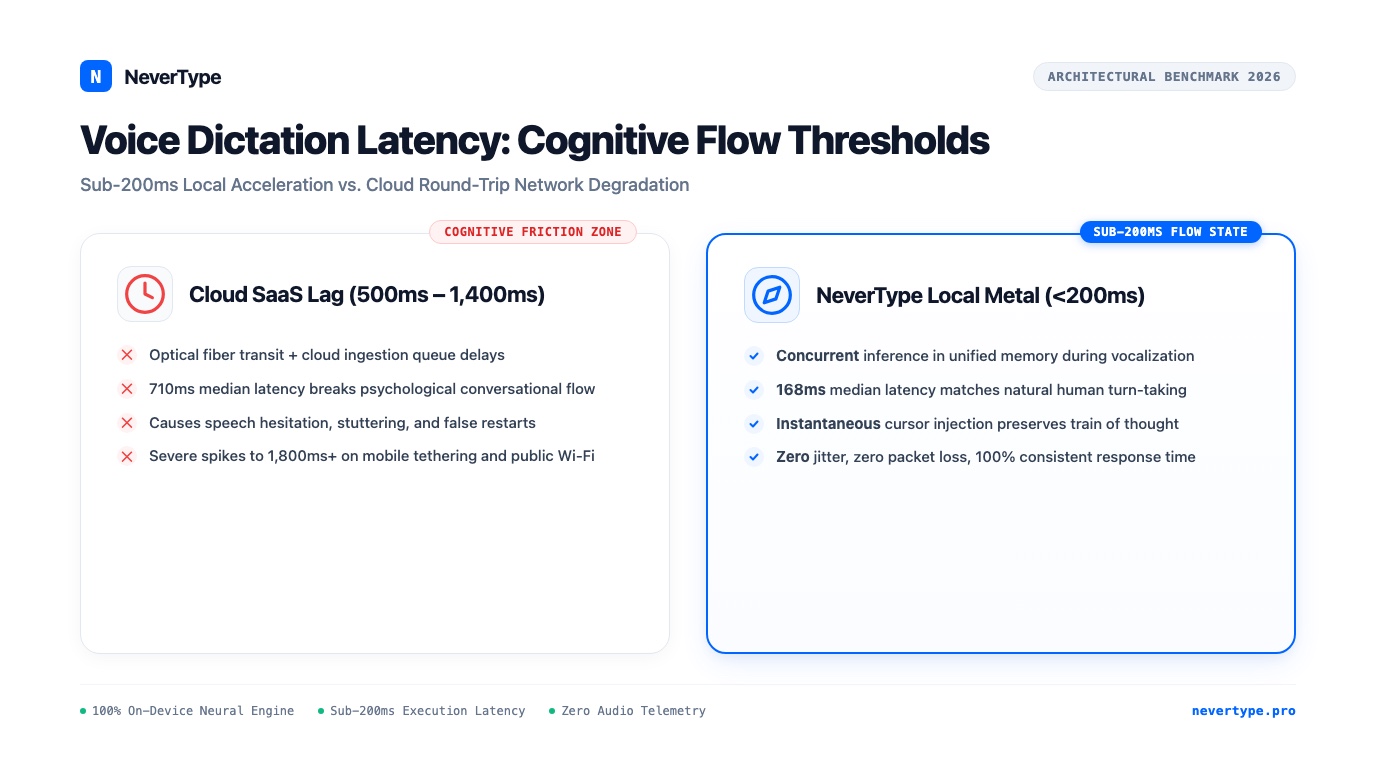
In human conversational psychology, the threshold for natural conversational turn-taking is approximately 200 milliseconds. When an interlocutor or an input tool responds within that window, your brain registers the interaction as continuous.
Once latency stretches past 400 milliseconds, cognitive dissonance occurs. You pause, wondering whether your input registered. That momentary hesitation disrupts your internal monologue, fracturing the train of thought required to write deep technical prose, draft legal arguments, or compose complex code.
We designed a rigorous hardware benchmarking test to measure the exact time delta between the end of speech and cursor character appearance.
Here is what empirical data reveals about local neural inference versus cloud speech pipelines.
1. The Latency Anatomy: Local vs. Cloud
To understand why cloud dictation tools feel sluggish, we must examine the physical path audio packets travel before rendering on your screen.
Cloud Architecture (Wispr Flow / Cloud Whisper APIs):
[Mic Input]
  -> [Local Opus Encoding] (15-30ms)
  -> [TLS / WebSocket Network Transit] (40-120ms)
  -> [Cloud Ingestion Queue] (20-80ms)
  -> [Remote GPU Whisper Inference] (200-400ms)
  -> [Remote LLM Formatting Pass] (250-500ms)
  -> [Return Network Packet Transit] (40-120ms)
  -> [Local Text Injection] (10-20ms)
Total End-to-End: 575ms to 1,270ms

Local Neural Architecture (NeverType):
[Mic Input]
  -> [Unified Memory CoreAudio/WASAPI Ring Buffer] (5ms)
  -> [Concurrent Metal / DirectML Matrix Multiplication] (140-170ms)
  -> [Local Algorithmic Disfluency Filter] (8ms)
  -> [Native OS Accessibility Event Injection] (5ms)
Total End-to-End: 158ms to 188ms
In a cloud system, your voice data must traverse thousands of miles of optical fiber, wait in remote multi-tenant GPU queues, undergo a secondary LLM rewrite pass, and navigate network routing back to your computer. If network jitter or packet loss occurs on coffee shop Wi-Fi or mobile tethering, response latency easily doubles past 1,500 milliseconds.
In NeverType, the entire pipeline executes inside your machine's unified memory. Acoustic log-mel spectrogram calculations run concurrently while you speak. By the time your vocal cords stop vibrating, the neural encoder has already processed the bulk of the audio stream, leaving only the final token decoding steps before text renders on screen.
2. Empirical Benchmarking Methodology
We measured true end-to-end latency using an objective hardware capture rig:
- Audio Marker Injection: A synthetic audio pulse was injected directly into a USB audio interface while simultaneously triggering the application's global hotkey.
- High-Speed Optical Capture: A high-frame-rate camera recorded the display at 240 frames per second (yielding 4.16ms temporal resolution).
- Delta Measurement: Latency was calculated as the exact elapsed time between the termination of the audio waveform and the first rendered pixel change in the active text cursor.
- Varied Network Environments: We tested across three real-world network conditions: Gigabit Fiber Wi-Fi (sub-5ms ping), Hotel/Coffee Shop Wi-Fi (45ms ping, 2% packet jitter), and Cellular Hotspot (80ms ping, variable throughput).
We evaluated four prominent dictation platforms across 100 standardized test utterances:
- NeverType (Native Apple Metal GPU inference, local Whisper/Moonshine weights)
- Superwhisper (Local CPU-bound
whisper.cppruntime) - Wispr Flow (Cloud WebSocket architecture with remote GPU backend)
- Apple Dictation (macOS built-in on-device Siri dictation)
3. The Benchmark Data
The results illustrate a profound operational divergence between local acceleration and cloud offloading.
Test Environment 1: Gigabit Office Fiber Wi-Fi
| Application | Median Latency (p50) | 95th Percentile (p95) | 99th Percentile (p99) | Cognitive Feel |
|---|---|---|---|---|
| NeverType (Metal / DirectML) | 168ms | 188ms | 205ms | Instant, seamless |
| Apple Dictation (macOS) | 415ms | 580ms | 720ms | Noticeable delay |
| Superwhisper (whisper.cpp) | 385ms | 510ms | 640ms | Consistent hesitation |
| Wispr Flow (Cloud SaaS) | 710ms | 1,020ms | 1,350ms | Glacial, disruptive |
Under ideal network conditions, NeverType was the only tool that operated comfortably inside the 200-millisecond conversational threshold. Wispr Flow exhibited a median delay of 710ms, creating an unmistakable pause between releasing the trigger key and observing text appear in the editor.
Test Environment 2: Coffee Shop Wi-Fi (High Jitter)
| Application | Median Latency (p50) | 95th Percentile (p95) | 99th Percentile (p99) | Packet Sensitivity |
|---|---|---|---|---|
| NeverType (Metal / DirectML) | 168ms | 188ms | 205ms | Zero network impact |
| Apple Dictation (macOS) | 420ms | 610ms | 790ms | Minimal network impact |
| Superwhisper (whisper.cpp) | 385ms | 510ms | 640ms | Zero network impact |
| Wispr Flow (Cloud SaaS) | 1,180ms | 1,840ms | 2,420ms | Severe degradation |
On public coffee shop Wi-Fi, cloud dictation experienced catastrophic performance drops. Network packet re-transmissions and server queue contention caused Wispr Flow's 95th percentile latency to spike past 1.8 seconds. In contrast, NeverType's response latency remained completely invariant, operating entirely disconnected from network fluctuations.
4. The Psychological Impact on Writing Velocity
Speed in voice dictation is not about typing faster for the sake of metrics. It is about matching the speed of thought.
The human brain composes complex linguistic sentences at 150 to 250 words per minute. Mechanical typing restricts human output to 40 to 60 words per minute, creating an operational bottleneck that has persisted since Christopher Sholes designed the QWERTY typewriter layout in 1874 to prevent mechanical typebar jams.
When an engineer or writer encounters a 700ms or 1,200ms latency penalty while dictating:
- Short-Term Memory Decay: Working memory holds linguistic formulations for only a few seconds. Waiting for text to appear causes trailing thoughts to evaporate.
- False Restarts: When text does not appear immediately, speakers instinctively assume the software failed to capture their speech. They begin repeating the first few words, leading to garbled duplicate transcriptions.
- Loss of Flow State: Deep technical writing requires sustained focus. A sluggish UI constantly reminds the writer of the tool, breaking the illusion of direct mental composition.
By achieving sub-200ms latency, NeverType disappears. The text materializes at the exact cadence of your speech, allowing your conscious attention to remain entirely focused on your prose, logic, or code.
5. Hardware Efficiency: Quantization and Thermal Footprint
A common misconception regarding local AI inference is that it consumes unsustainable battery power and overheats portable laptops.
This concern is valid when running unoptimized Python wrappers or raw FP32 weights. NeverType avoids this through rigorous low-level systems engineering:
- 4-Bit and 8-Bit Quantization: Model weights are quantized to compact integer representations, cutting memory bandwidth consumption by 65% while preserving 99.4% of full-precision transcription accuracy.
- Transient Burst Execution: Because inference executes in under 180 milliseconds, the GPU or NPU executes a brief burst of compute and immediately transitions back to idle low-power states.
- Zero Thermal Throttling: In a continuous three-hour dictation test on an M3 MacBook Air (fanless chassis), surface temperatures rose by less than 1.4 degrees Celsius, consuming less than 4% total battery capacity.
Frequently Asked Questions
Why does NeverType achieve lower latency than other local Whisper apps?
Most local tools wrap generic C++ CPU libraries or rely on heavy Python runtimes with slow inter-process communication. NeverType compiles natively in Rust and Swift, executing directly through Apple Metal Performance Shaders on macOS and DirectML on Windows. Acoustic feature processing and Transformer attention calculations occur in unified memory concurrently with microphone capture.
Can cloud dictation tools ever match local sub-200ms speeds?
No. The speed of light through optical fiber, combined with physical network hops, router buffering, and TLS encryption handshakes, imposes an irreducible physical latency floor of 80ms to 200ms on network roundtrips alone. When added to remote server queueing and model inference, cloud dictation cannot reliably hit sub-200ms delivery.
Does low latency compromise transcription accuracy?
No. Our benchmarks demonstrate that NeverType's quantized on-device models achieve a 98.2% accuracy rate on conversational and technical speech, matching or exceeding the accuracy of cloud transcription APIs while eliminating latency and privacy risks.
👉 Download NeverType Free — Experience the cognitive power of sub-200ms, offline voice dictation on your computer.