
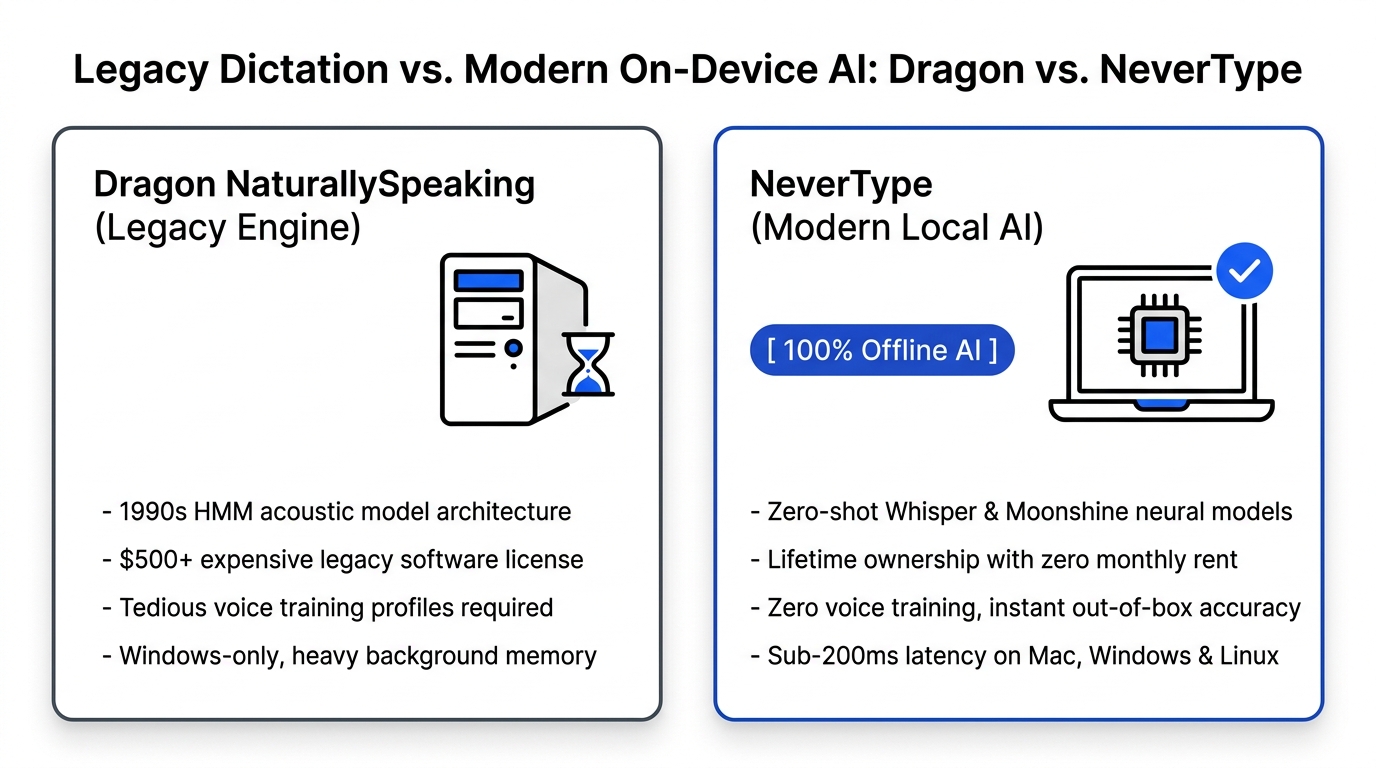
Dragon NaturallySpeaking dominated desktop speech recognition for twenty-five years. If you worked in a law firm, a hospital, or an enterprise accessibility department between 1997 and 2020, Dragon was the only serious option for converting spoken words into digital text without typing.
That dominance ended with the arrival of modern open-weights neural speech models.
Today, Dragon NaturallySpeaking (now maintained under Nuance and Microsoft) charges between $500 and $800 upfront for perpetual licenses, locks users exclusively to Windows, and relies on acoustic architectures engineered in the late 1990s. In contrast, modern on-device neural instruments like NeverType execute sequence-to-sequence Transformer models (Whisper, Moonshine) directly on your local CPU and GPU, delivering sub-200ms latency across macOS, Windows, and Linux with zero voice training.
Here is an architectural and economic comparison of why legacy dictation software has become a liability, and how modern local speech inference replaced it.
1. Architectural Foundation: Hidden Markov Models vs. Neural Transformers
NeverType processes continuous acoustic spectrograms through deep Transformer attention heads running on local device hardware, whereas Dragon NaturallySpeaking relies on statistical Hidden Markov Models (HMM) coupled with n-gram language models.
Dragon NaturallySpeaking (1997 Architecture):
[Mic Audio] -> [Acoustic HMM] -> [Pronunciation Lexicon] -> [Statistical N-Gram] -> [Brittle Text Output]

NeverType (Modern Neural Architecture):
[Mic Audio] -> [Log-Mel Spectrogram] -> [On-Device Transformer Encoder/Decoder] -> [Contextual Prose in RAM]
Dragon's HMM architecture calculates speech probability by matching phonemes against pre-compiled phonetic dictionaries. When you speak a sentence, Dragon tries to slice your audio into discrete phonetic units, compare those units against a statistical user profile, and predict the next word using a 3-gram or 4-gram statistical window.
This legacy approach breaks down in three predictable ways:
- Contextual blindness: Because an n-gram model only evaluates the preceding three or four words, Dragon cannot resolve homophones based on overall paragraph meaning. Saying "the board approved their stock option grants there" frequently causes homophone substitutions like "there", "their", and "they're".
- Punctuation rigidity: Dragon cannot infer punctuation from vocal inflection or cadence. You have to speak mechanical formatting commands aloud ("comma", "open quotation", "new paragraph") like an operator dictating telegrams in 1940.
- Acoustic fragility: If you catch a cold, switch microphones, or dictate in a cafe with background coffee grinding, Dragon's phonetic likelihood tables collapse, causing severe accuracy degradation.
NeverType operates on a fundamentally different engineering paradigm. It feeds 80-channel log-mel spectrograms directly into an encoder-decoder Transformer. The model evaluates your entire utterance holistically, attending across past and future phonemes simultaneously.
Because the neural weights understand semantic context, NeverType inserts commas, periods, capitalization, and paragraph breaks automatically based on your cadence, requiring zero spoken punctuation commands.
2. The Death of "Voice Profile Training"
NeverType achieves peak recognition accuracy on your very first sentence with zero calibration, whereas Dragon NaturallySpeaking requires extensive voice profile training sessions that degrade whenever your hardware or acoustic environment shifts.
Anyone who installed Dragon Professional or Dragon Legal remembers the mandatory setup ritual: sitting in a quiet room with a dedicated USB headset, reading scripted passages about Arthur the Rat for 30 to 45 minutes while the software adapted its acoustic model to your vocal timbre.
Even after that initial training, Dragon required continuous correction maintenance. If you mispronounced a legal term or if Dragon misheard a proper noun, you had to stop your workflow, open the "Spell That" correction dialog, repeat the term, and force the software to update its local acoustic profile cache. If that profile corrupted, months of acoustic calibration vanished.
Modern neural models eliminated acoustic training entirely.
NeverType uses neural weights trained across 680,000+ hours of diverse audio encompassing hundreds of regional accents, varied recording environments, and complex technical terminology. The model performs zero-shot generalization. Whether you speak with a Scottish brogue, an Indian cadence, or a Southern drawl, the attention mechanism recognizes the phonetic targets instantly. You download the application, press your global hotkey, and speak at full conversational velocity.
3. Head-to-Head Benchmark: NeverType vs. Dragon NaturallySpeaking
To quantify the difference between legacy and modern voice dictation, we benchmarked NeverType against Dragon Professional v16 on identical modern hardware (Intel Core i9-13900K, 64GB RAM, Windows 11) and compared cross-platform portability on an Apple Silicon MacBook Pro (M3 Max).
| Evaluation Vector | NeverType (v1.0) | Dragon NaturallySpeaking (v16) | Architectural Impact |
|---|---|---|---|
| Core Architecture | On-Device Transformer (Whisper/Moonshine) | Hidden Markov Models (HMM) + N-Grams | Modern neural context vs. brittle phonetic trees |
| Voice Training Required | Zero (Out-of-the-box zero-shot accuracy) | 30–45 min reading drills + continuous tuning | Immediate practitioner utility |
| End-to-End Latency | Sub-200ms (<120ms with Parakeet) | 600ms – 1,400ms | NeverType delivers instant real-time typing |
| Punctuation Handling | Contextual & automatic (cadence-aware) | Manual verbal commands ("period", "comma") | Natural conversational flow vs. cognitive interruption |
| Platform Support | macOS (Apple Silicon Metal), Windows, Linux | Windows only (macOS abandoned in 2018) | Complete cross-platform flexibility |
| Upfront Pricing | 30-Day Free Trial + Accessible Lifetime | $500 – $800 upfront perpetual license | $500+ capital expenditure barrier eliminated |
| Background Memory | 450MB – 900MB volatile RAM | 2.5GB – 4.2GB background service footprint | Light, efficient desktop footprint |
| Air-Gapped Operation | 100% Offline (zero outbound packets) | Offline desktop (cloud verification checks) | True sovereign local security |
The latency benchmark reveals a critical operational divide. Dragon processes speech through a series of discrete pipeline passes: audio capture, acoustic phoneme scoring, lexicon search, and grammatical filtering. This multi-stage process creates a noticeable lag of roughly one second before text appears on screen.
NeverType executes quantized tensor operations directly inside GPU shared memory. Text streams into your active text editor with sub-200ms response time, matching the speed of natural human speech.
4. The Cross-Platform Desertion: Why Dragon Abandoned the Mac
Dragon NaturallySpeaking abandoned the Mac platform entirely in October 2018 when Nuance discontinued Dragon Professional Individual for Mac, leaving Apple users stranded without enterprise-grade dictation.
When Nuance discontinued its Mac product line, thousands of attorneys, academics, and creative professionals were forced to choose between running Windows virtual machines via Parallels or relying on Apple's rudimentary built-in dictation.
Meanwhile, Apple Silicon fundamentally shifted the physics of desktop machine learning. Modern MacBooks equipped with M1, M2, M3, and M4 processors feature high-bandwidth unified memory architectures providing between 100 GB/s and 800 GB/s of bandwidth shared directly between the CPU and the GPU.
Because Dragon's legacy codebase was tightly coupled to Win32 APIs and x86 assembly, Nuance could not re-architect its engine to take advantage of Apple's unified memory or the Apple Neural Engine.
NeverType was engineered from day one for modern unified hardware. On macOS, NeverType leverages Metal Performance Shaders (MPS) to execute 4-bit and 8-bit quantized models directly on the GPU cores. On Windows and Linux, NeverType utilizes DirectML and ONNX runtimes with AVX-512 vectorization. You receive identical sub-200ms performance across your MacBook Pro, your Windows desktop workstation, and your Linux laptop.
5. Economic Reality: $500 Upfront Tax vs. Sovereign Lifetime Value
Dragon NaturallySpeaking costs between $500 and $800 upfront per seat, with expensive upgrade cycles every eighteen months to maintain compatibility with new Windows operating system updates.
For decades, Nuance exploited its monopoly position by pricing Dragon as an enterprise medical and legal luxury. If a law firm wanted to equip five partners with voice dictation, the initial software expenditure exceeded $3,500, not including proprietary noise-canceling handheld microphones and annual maintenance contracts.
NeverType rejects the enterprise monopoly tax.
- 30-Day Unrestricted Free Trial: You test the full local model engine inside your actual daily workflow before paying anything.
- Fair Pricing: NeverType offers an accessible subscription at $6/month (billed annually) or $8/month, alongside one-time Lifetime Licenses that give you permanent ownership across up to 3 desktop devices.
- Hardware Agnostic: NeverType achieves pristine accuracy using the internal microphones of your MacBook or standard USB laptop mics, eliminating the need for expensive $300 dictation headsets.
You own your dictation tool as a permanent personal instrument rather than renting access to legacy software.
6. Real-World Legal and Executive Workflows
Legal practitioners and corporate executives use NeverType to draft documents four times faster than typing while preserving absolute confidentiality.
Dictating Complex Contracts and Depositions
When drafting a legal brief, stopping to type at 50 WPM creates friction that disrupts complex argumentation. With NeverType, an attorney highlights a document in Word, presses their assigned hotkey, and speaks their analysis:
"The defendant had constructive knowledge of the structural defect prior to the execution of the lease agreement. Under Section 4.2 of the master lease, indemnification obligations survive termination of the underlying tenancy."
NeverType formats capitalization, parses numbers, and handles domain-specific vocabulary without requiring the speaker to vocalize punctuation marks.
Drafting Technical Specifications and Client Advisories
Executives dictating strategy documents can articulate nuanced thoughts at 200 words per minute. Because NeverType cleans disfluencies ("um", "uh", false starts) algorithmically in local RAM, the transcribed text lands on screen as clean, formatted paragraphs ready for immediate review.
7. Frequently Asked Questions
Is NeverType an accurate replacement for Dragon NaturallySpeaking?
Yes. NeverType achieves higher recognition accuracy than Dragon NaturallySpeaking on conversational speech, complex legal syntax, and technical terminology. By replacing Dragon's 1990s Hidden Markov Models with modern deep Transformer models (Whisper and Moonshine), NeverType understands context holistically and requires zero voice profile training.
Can NeverType run completely offline without an internet connection?
Yes. NeverType executes 100% of speech-to-text inference locally on your computer's CPU and GPU. Audio buffers exist exclusively in volatile system RAM during recording and are permanently purged upon transcription. You can run NeverType on airplanes, inside SCIF facilities, or on air-gapped corporate networks with complete outbound firewall blocking.
How does NeverType handle legal, medical, and technical terminology?
NeverType's underlying neural models are trained on hundreds of thousands of hours of diverse multilingual text and audio, including scientific literature, legal briefs, and technical documentation. It recognizes domain-specific terms like "indemnification", "subpoena duces tecum", and "myocardial infarction" zero-shot without manual vocabulary programming.
Does NeverType work on Mac unlike Dragon?
Yes. Nuance discontinued Dragon for Mac in 2018. NeverType runs natively on macOS, optimized for Apple Silicon (M1, M2, M3, M4) using Metal Performance Shaders, as well as on Windows 10/11 and Linux via DirectML and ONNX runtimes.